
Ask ten people in this industry "are peptides legal?" and you'll get ten different answers. Some will say yes. Some will say absolutely not. Most will shrug.
They're all sort of right, which is the frustrating part. Are peptides legal? It depends on which peptide, who made it, who's buying it, and what you told them it does. That last one matters more than sellers think.
Let's clear this up.
The Short Version
Are peptides legal in the United States? Mostly yes, with real limits attached. The peptide sitting in the vial is rarely what gets a company in trouble. It's the words on the website. Two shops can sell the exact same compound. One is fine. The other gets a warning letter. The difference is what they claimed it does.
So when someone asks "are peptides legal," the better question is: legal to do what, exactly?
How the FDA Actually Sorts Them
There's no single bucket labeled peptides, which is exactly why "are peptides legal" has no clean answer. They land in a few different places.
Semaglutide and tirzepatide went through the full testing process and came out the other side with FDA approval. Doctors prescribe them. Pharmacies fill them. No gray area.
Licensed pharmacies working under 503A and 503B rules can make certain peptides for patients who have a real prescription. That's legal too.
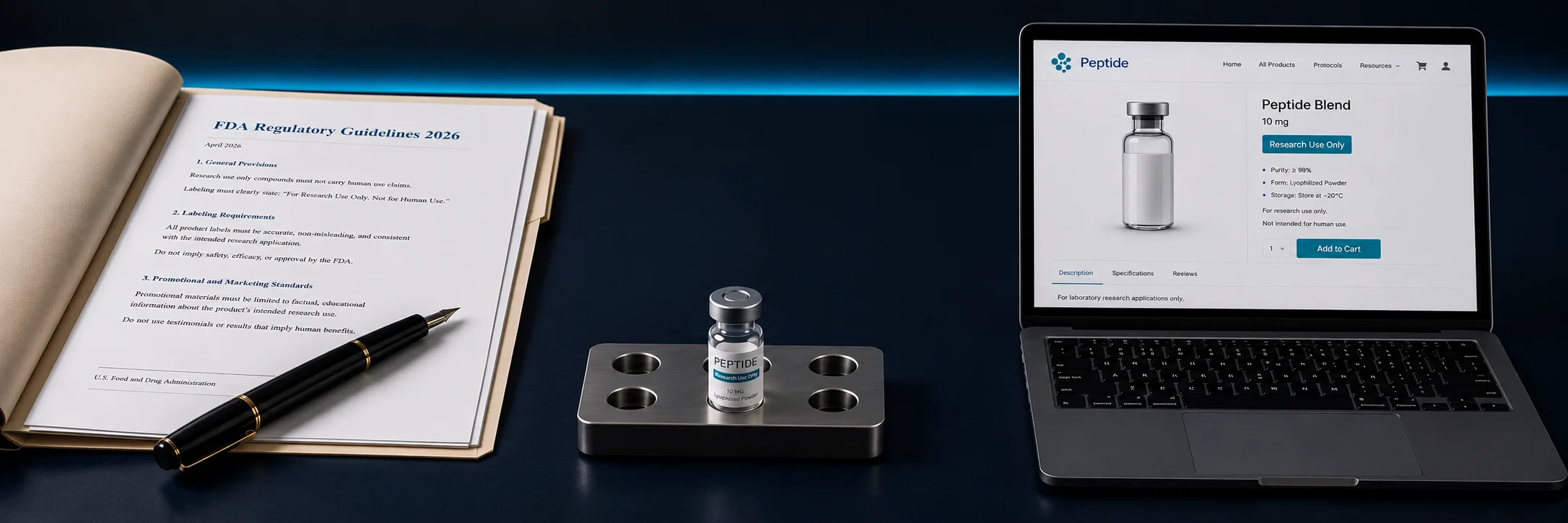
Everything else, sold with a "research use only" label. This is most of what you see on vendor sites. These aren't meant for people to take, and that label is doing a lot of work.
What Changed in 2026
This part has been messy, and it's why the answer to "are peptides legal" keeps moving. Knowing the story helps.
Late 2023, the FDA dropped 19 peptides into something called Category 2. Translation: pharmacies couldn't compound them anymore. BPC-157 and TB-500 were both on that list, which annoyed a lot of people.
Then the wind shifted. Early 2026 brought new leadership at HHS pushing to loosen things up. By April, the FDA had pulled BPC-157, TB-500, and several others back off the restricted list.
"Research Use Only" Isn't a Magic Shield
Plenty of sellers treat that label like a force field. Slap it on, sell whatever, sleep fine.
It doesn't work that way.
If your product page says research use only but your blog post says it heals tendons, your ad says it burns fat, and your Instagram says it turns back the clock, the label means nothing. Regulators read the whole picture, not just the fine print. What you say about a product is part of what the product legally is.
This is where most peptide businesses actually get burned. Not on the chemistry. On the copy.
Is It Legal to Advertise Peptides?
This is the question you really came for.
Short answer: yes, within limits, and there are two separate walls to get over.
You can market peptides as research chemicals. You cannot say they treat, cure, prevent, or improve anything in a human being. No disease claims. No muscle claims. No fat loss claims. No "supplement" framing. Cross that line and you've turned a research chemical into an unapproved drug, at least in the eyes of the agency reviewing your site.
Google and Meta block peptide ads routinely, even for businesses doing everything right. Their rules are stricter than the actual law and they don't owe you an explanation. Accounts vanish overnight. That's why the peptide brands that last don't build on rented land. They build on SEO, content, and email, where nobody can flip a switch and end their business on a Tuesday.
Staying on the Right Side

Knowing the answer to "are peptides legal" is step one. Living it day to day is step two. A few habits that keep peptide businesses out of trouble:
Label honestly and then act like you meant it.
Skip health claims completely, even the soft ones hiding in customer reviews you chose to feature.
Watch the FDA, because this area moves.
Lean on channels that won't ban you.
When something feels close to the line, ask a lawyer who actually knows FDA work, not a general business attorney.
None of this is exciting. All of it is cheaper than a warning letter.
So, Are Peptides Legal?
Yes, and no, and it depends, which is a lousy answer but a true one.
Fully legal. Prescribed by doctors, dispensed by licensed pharmacies.
Legal with a valid prescription behind them from a licensed pharmacy.
Legal to sell for research. The moment they get marketed for human use without approval, the answer flips.
For anyone running a peptide business, the takeaway is simple even if the rules aren't. Sell research products as research products. Keep the claims off. Watch the FDA. Build traffic you own.
The Bottom Line
Most peptide brands don't get in trouble on purpose. They get in trouble because one product page, written two years ago by a freelancer, says something it shouldn't.
PeptAds works with peptide brands only. We know where the line sits and how to grow traffic without ever getting near it. Send us your site and we'll tell you what we see.
Not Sure If Your Marketing Crosses the Line?
Most peptide brands don't get in trouble on purpose. They get in trouble because one product page, written two years ago by a freelancer, says something it shouldn't. Send us your site and we'll tell you what we see.
Get a Peptide Marketing Review